
We know that you are completely exhausted and utterly heartbroken. We are too.
On face value we lost, but there is more to the result than meets the eye and this was anything but a fair fight. Two years ago, we started off with Yes on a poll of 25% and yet we ended up with 45%. The sheer resilience of the Yes movement in the face of the full might of the British state, corporate and media power, that was designed to demonise, smear and alienate anyone who chose to side with it will not die down. We’ve been looking straight into the eyes of the British establishment, and we don’t think much of what we see sneering back at us.
From the very beginning, the then ‘Better Together’ turned ‘UKOK’ turned ‘No Thanks’ campaign threw every toy out of the basket, played every dirty trick in the book, and ran a campaign based on negativity and scaring the population into thinking that we were not actually capable of running our own affairs. What we were faced with was a campaign based on stifling engagement, dumbing down politics and deadening thought whilst portraying a No vote as the rational, educated and realistic option.
One of the most heartbreaking moments in the campaign will be a familiar one for many. Knocking on doors and being confronted with an elderly person who had postal-voted No because they were told that they would lose their pension. The No campaign had shamelessly managed to convince people that, in the 14th richest country in the world, we could not afford pensions. The fear tactics employed were sickening. They threw everything under the sun at us, but not once did it dampen our spirits. We canvassed, we danced, we wrote, we sang, we campaigned. And we will continue to do so.
Aside from the fear tactics, this was a campaign aspiring to deaden thought, simplify politics and close minds. #PatronsingBTLady proved an excellent illustration of such, as was the ‘I love my family, I’m saying No Thanks’ billboards, and let’s not forget the ‘independence stresses me out’ stress balls handed out at freshers fayres. This is how they see us. They think we are passive, disinterested, selfish and stupid. In contrast, National Collective toured the country on Yestival, Radical Independence knocked on tens of thousands of doors in a day on their Mass Canvasses, tens of thousands of activists reached out to apathetic communities through local groups, Generation Yes ran open platforms on social media where young people could ask us anything – the entire Yes movement was about encouraging people to think and imagine.
Despite the ‘Better Together’ campaign being what is unquestionably one of the most incompetent political campaigns in the history of British politics, what hindered the steady surge to Yes was a largely compliant mainstream media. For example, a Guardian journalist sent us sarcastic e-mails refusing to publish details of a list of 1,300 prominent artists and creatives who had signed a letter backing a Yes vote, Dr John Robertson’s academic work proved the evident systematic bias of the BBC, and we were constantly demonized as anti-English separatist nationalists and, at times, ‘fascists’ despite many of us being English, and some of us knowing the journalists personally. If they cannot win through an honest factual campaign, what does this say about their case?
Aside from the blatant smearing of anything Yes, the press did something significantly more sinister. They controlled the dissemination of information, closed the space for Yes voices to be heard, and thus facilitated and legitimised the scaremongering onslaught from the No campaign. How many times did you hear that ‘there are just too many unanswered questions’, despite the questions being answered? How many times did you hear that people were voting No because they didn’t like nationalism, despite us not being nationalists? To suggest that British identity is in no way nationalistic derives from a neo imperialist mindset. How many times did you see Alistair Darling and Alex Salmond compared to Dennis Canavan? How many people do you honestly think were aware that Salmond wasn’t the leader of Yes? This was most evident during the last week of the campaign, when we saw the Telegraph stating that voting Yes was an insult to dead soldiers and their families. The establishment’s compliant media was the cherry on top of the cake; a systematic abuse of power.
Did we let this deliberate misrepresentation and demonisation take us down? No. We became the media. Stephen Paton released his #IndyRef weekly reviews, websites like National Collective and Bella Caledonia became a space for underrepresented Yes voices to be heard, and we took to social media to overcome the smear and spread our progressive visions. We should point out here that the Sunday Herald, in supporting Yes, demonstrated courage throughout this movement. It’s not easy to go against the tide of mainstream media opinions and portrayals. The Yes movement should be incredibly proud of our ingenuity and tireless determination and we mustn’t let it dwindle.
Within the political landscape of the No campaign, Scottish Labour provided the front whilst the Tories pulled the strings and supplied the funds. If they were honest democrats, Scottish Labour should have held an election within their party regarding which stance to take on the referendum. The Scottish Green Party for example voted on it, and maintained that members who supported No could speak freely on the matter. This was the first indication that Scottish Labour were about to ostracise those demonstrating autonomy in their party. And boy did that happen. They were openly seen and heard mocking Yes supporting Labour members at their party conference.
Despite Scottish Labour supporting a No vote, around 38% of their voters supported Yes. The Scottish Labour Party ignored their own supporters, and instead blindly persued an agenda that panders to the Labour Party in Westminster, a party that is out of touch with the people of Scotland and one that they have overwhelmingly rejected. One of the results of this is that we are now witnessing memberships of the SNP, the Scottish Green Party and the Scottish Socialist Party skyrocket overnight. Scottish Labour have risked alienating 38% of their own vote in Scotland to preserve a failing Westminster elite. This highlights how little regard they have for the Scottish political landscape. True power, they believe, lies at Westminster.
Taking all of this into consideration, and acknowledging that we were challenging the full force of the British establishment, their corporate might and their compliant media, we did bloody well. If we were at the forefront of a campaign with that level of influence, power and money, we would see a 55% as an international embarrassment.
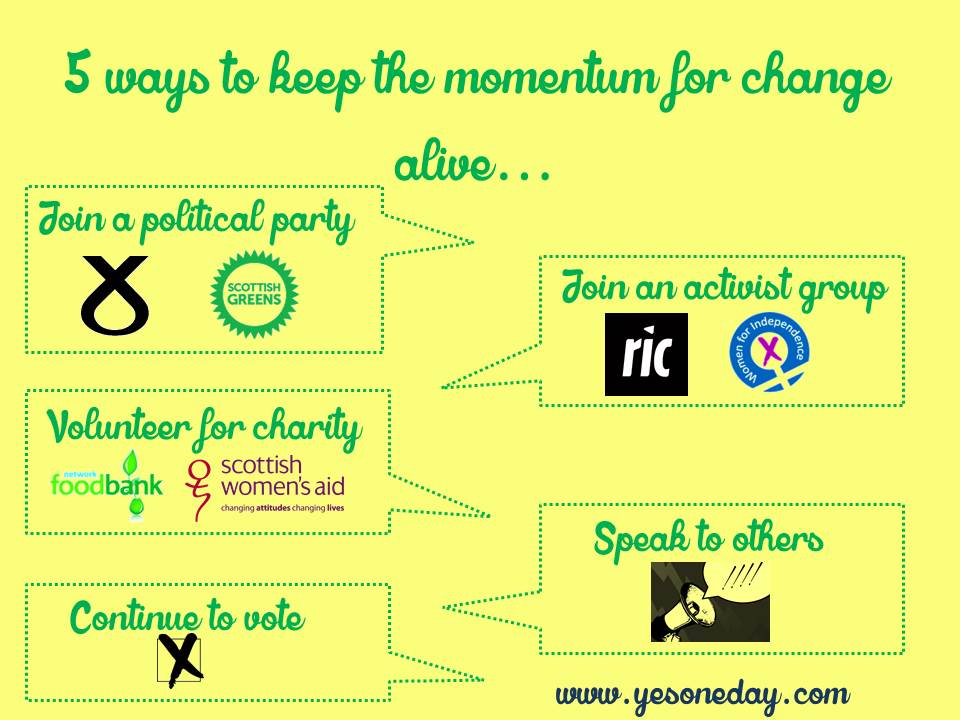
Part of the reason that we saw the groundswell of grassroots activism that we did is because there was a deadline, a common shared goal for September 18th 2014. Although the deadline has been removed, we still have that shared aspiration. The question now is how to we encapsulate and maintain the momentum of this progressive, diverse, grassroots movement?
The first means of achieving this is clear. The vast majority of the mainstream media have demonstrated their complete lack of autonomy and level of compliance to the British establishment and the corporate elite. We need to create and preserve alternative media channels. But there is little point in creating them as a protest to the mainstream media. These alternative channels must become the mainstream. To do so requires working together. There are some utterly brilliant and resourceful people in this movement. It’s time to unite.
Secondly, we need to organise ourselves with the common aim of holding Westminster accountable to the promises that they made to us. This starts with their pledges for further devolution. We expect that this won’t happen. 1 in every 4 No voters casted their vote under the promise of further devolution. If these promises fail to transpire, we will seek to secure a date for the next referendum on Scottish independence. We have various options as to how we can help make this happen, and we will update you on this later should it be required.
Thirdly, as stated above, the Yes movement seeks to make people think. It is our duty to continue to create a politically engaged, educated electorate. What Westminster want is a Yes movement that is so utterly deflated that it regresses into the shadows, it stops dreaming, it stops imagining that another Scotland is truly possible. There is a reason why the likes of Rupert Murdoch expressed concern at the influence of progressive Yes groups in Scotland.
We simply cannot afford to let our beautiful movement regress. 1.6 million of us stood up and dared to dream. We lost by the equivalent of the population of a small city. We can win this, we must win this, we will win this. When you get a popular revolution driven by hope and optimism like this, that energy will not dissolve into nothing. It can only grow. In the aftermath of a normal election, the losing party is disheartened and their supporters deflated. The difference here is that the whilst the official No campaign has finished and will no doubt try to delete all evidence of it ever existing, people still make the Yes movement and we will continue to campaign and dream. We will always put hope over fear.
National Collective had made plans to continue the Yes movements legacy of a politically engaged and educated electorate, regardless of the result. We will be announcing details of this shortly.
Keep imagining a better Scotland.
National Collective





 Yes One Day